


Home First Steps -
Childhood in Zanzibar Growing up in India
Culture Shock Her Majesty -
The Queen ‘No Bed Of Roses’ ‘Love Of My
Life’ ‘Bohemian Rhapsody’
The Great Pretender Live Aid An Evening At
The Opera Mercury - the musician The all-round
artist Mercury - the prophet Last Days The Legend The Queen
File
FMQ in German FMQ-GALLERY My Fairy King
video Freddie Mercury memorial site Guestbook/Contact Gateway page QUEEN NEWS Links BOOKS ARTICLES
Brian May Roger Taylor John Deacon Miscellaneous Philosophy
corner Updates
Official biography People about
Freddie About Me
PHILOSOPHY CORNER
© logo/ pic
by Daria Kokozej, 2007-04-27
(2006-2010): As a philosophy student, I just thought I’d
start a section which is about PHILOSOPHY (greek
‘philosophía’/ ‘φιλοσοφία’:
the “LOVE”/”striving” for knowledge/’WISDOM’). When you are philosophizing, you
also seek to reach the ‘truth’ about certain things. Some fragments will be
here just for entertainment, some others (like quotes or thoughts of philosophers for example) out of interest which you can then take up and continue if you
like…
2013 status/ statement: since couple
of years, after all kind of questions, seeking etc. I am a “born-again”
Christian; I was interested in religion since I was a teen, but it took time and
now I strongly have faith in Jesus Christ and the God He revealed, and the word
of God (the New Testament); I think philosophy, reading and education/
knowledge is still very important, because it teaches you to THINK, and the
more you know, the better you are able to separate true from false - “knowledge is power” - but I felt
the “final basis” was always missing, or you can call it the direction of life
– this direction is found in faith, and I found it in (“true”) Christianity
(people who abuse Christian faith to kill other people are not Christians to
me, there is a lot of abusing and misusing going on – those people are bad and
not true Christian faith itself...);
I think, in the end it is good that I pursued philosophy, finding out
what is not so good and suspicious to me. I could also find out what is WRONG
philosophy and a “wrong view of life”. There is philosophy that propagates
nihilism etc etc and I
think this philosophy is an instrument to harm people’s souls and to control
them... If you like to know more, there are sure many books on these complex
topics, you just have to look for them (search the internet for key words) or
you can write me :-)
Enjoy and stay in tune!
+++
Little special:
some topics and questions of philosophy (2010)
the world of philosophy…
the world of thinking…
the world of perception, ideas, views, insights…

(auguste
rodin – the thinker)
So,
well, what are the thinkers who were most inspirational to humankind?
Without
a doubt, Greek philosophy (in the western world)… Plato, Aristotle… - and
Christianity? Is Christianity a philosophy? Is it “only” a religion? What is
this, a religion? How can we understand it?
As
you/ we see many questions, many answers… searching for answers… searching for truth, for
something you can rely on, for a sort of guide…
I think, there can be nothing “constructive”, no “creation” (in the
metaphorical sense of this word) in this world without something “metaphysical”.
That means, there can be no life or living without any
principles, without love,
without a goal, without a certain spirituality; no “living” and maybe even no happiness
without all these “things”…
We
human beings have a natural “metaphysical” and spiritual side to us, we have a
“soul”/soul, even if some (even philosophical) directions/schools do tell us
the opposite… now I think such misunderstandings are
the results of not enough information, or manipulation, or just lack of knowledge…
“Forgive them Father, because they do not KNOW what they do” the Bible says.
They are not AWARE… how important it is to get an AWARENESS of
what you are doing, of what you’re feeling, speaking… if it is right or wrong… good or
bad/ evil… - because EVERYTHING turns to reality…
everything we do, feel, speak, does “create” the world we are living in…
After
all, how can you live without any guide?
For a
philosopher it takes a lifetime of argumentation, thinking through, living through
all the questions that we are asking: Who is God... what is God… Who are
we? What is a human being?
(Immanuel Kant) What is the meaning of life? What is
good and what is evil? These are many different and complex questions and it
shows how accurate we have to be to answer them, to get just a little insight.
© Daria Kokozej,
September 2010 (revised 2013 and 2014,
please see statement above)
+++
a summarised portrait of the religion
Freddie Mercury was born into (information taken from Wikipedia and http://www.religioustolerance.org/zoroastr.htm)
I don’t know if Freddie Mercury was himself a Zoroastrian,
because he wrote also a song about Jesus and he sang mostly about the God
Christians know...
Zoroastrianism:
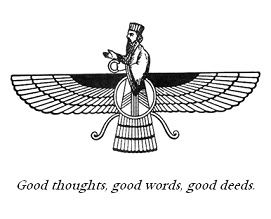
The Zoroastrian faith is claimed to be the earliest monotheistic religion
with a dualistic nature.
The religion itself was founded by Zarathustra (Zoroaster in
Greek; Zarthosht in
Today, small Zoroastrian communities are found in
Parsis have gained a reputation for
their education (today, around 70% of Parsis in the
The attributes of
Zoroastrian faith are:
·
A single god Ahura Mazda who is supreme
·
One school of thought
promotes a cosmic dualism between the all powerful
God Ahura Mazda who is the only deity
worthy of being worshipped, and an evil spirit of violence and death, Angra Mainyu, who
opposes Ahura Mazda. The resulting cosmic conflict
involves the entire universe, including humanity who is required to choose
which to follow. Evil, and the Spirit of Evil, will be completely destroyed at
the end of time. Dualism will come to an end and Goodness will be all in all.
Another school of thought perceives the battle between Good and Evil as an
ethical dualism, set within the human consciousness – the persistent conflict between Good and Evil
that distinguish Zoroastrian morality is summed up in the simple phrase, “Good
Thoughts, Good Words, Good Deeds”. Predestination is rejected in
Zoroastrian teaching. Humans bear responsibility for all situations they are
in, and in the way they act to one another. Reward, punishment, happiness and grief all depend on how
individuals live their life. Good befalls the people who do righteous deeds.
Those who do evil have themselves to blame for their evil-doing.
·
The symbol of fire: The
energy of the creator is represented in Zoroastrianism by fire and the sun
which are both enduring, radiant, pure and life sustaining
·
Death and burial:
Religious rituals related to death are all concerned with the person’s soul and
not the body. Zoroastrians believe that on the fourth day after death, the
human soul leaves the body and the body remains as an empty shell.
Traditionally, Zoroastrians disposed of their dead by leaving them atop
open-topped enclosures, called Towers of Silence, or Dokhmas. Vultures and the weather would clean the flesh of
the bones, which were then placed into an ossuary at the center of the Tower.
Fire and Earth were considered too sacred for the dead to be placed in them.
While this practice is continued in India by some Parsis,
it had ended by the beginning of the twentieth century in Iran. In India,
burial and cremation are becoming increasingly popular alternatives
·
The Zoroastrian holy book, called Avesta, does not only contain religious literature but also works on Medicine,
Astronomy, Botany and Philosophy
·
Unlike Christianity,
Zoroastrianism is a non-proselytising religion, and if you are not born one, it
is very difficult to become one
© Copyright 2006 - 2014; Daria Kokozej (Contact Me)