


Home First Steps -
Childhood in Zanzibar Growing up in India
Culture Shock Her Majesty -
The Queen ‘No Bed Of Roses’ ‘Love Of My Life’
‘Bohemian Rhapsody’
The Great Pretender Live Aid An Evening At
The Opera Mercury - the musician The all-round
artist Mercury - the prophet Last Days The Legend The Queen
File
FMQ in German FMQ-GALLERY My Fairy King
video Freddie Mercury memorial site Guestbook/Contact Gateway page QUEEN NEWS
Links
BOOKS
ARTICLES
Brian May Roger Taylor John Deacon Miscellaneous Horoscope Philosophy
corner Updates
Official biography People about
Freddie About Me
BOHEMIAN RHAPSODY
‘Praying’:

“Is this the real life –
Is this just fantasy –
Caught in a landslide –
No escape from reality –
Open your eyes
Look up to the skies and see –
I’m just a poor boy, I need no sympathy –
Because I’m easy come, easy go,
A little high, little low,
Anyway the wind blows, doesn’t really matter to me,
– to me –
Mama, just killed a man,
Put a gun against his head,
Pulled my trigger, now he’s dead,
Mama, life had just begun,
But now I’ve gone and thrown it all away –
Mama, ooo –
Didn’t mean to make you cry –
If I’m not back again this time tomorrow –
Carry on, carry on, as if nothing really matters –
Too late, my time has come,
Sends shivers down my spine –
Body’s aching all the time,
Goodbye everybody – I’ve got to go –
Gotta leave you all behind and face the truth
Mama, ooo – (anyway the wind blows)
I don’t want to die,
I sometimes wish I’d never been born at all –
I see a little silhouetto of
a man,
Scaramouch, Scaramouch will you do the Fandango –
Thunderbolt and lightning – very very frightening me
–
Gallileo, Gallileo,
Gallileo, Gallileo,
Gallileo Figaro – Magnifico
–
But I’m just a poor boy and nobody loves me –
He’s just a poor boy from a poor family –
Spare him his life from this monstrosity –
Easy come easy go –, will you let me go –
Bismillah! No –, we will not let you go – let him go
–
Bismillah! We will not let you go – let him go
Bismillah! We will not let you go – let him go
Will not let you go – let me go
Will not let you go – let me go
No, no, no, no, no, no, no –
Mama mia, mama mia, mama mia let me go –
Beelzebub has a devil put aside for me, for me –
for me –
So you think you can stone me and spit in my eye –
So you think you can love me and leave me to die –
Oh baby – can’t do this to me baby –
Just gotta get out – just gotta
get right outta here –
Nothing really matters,
Anyone can see,
Nothing really matters –, nothing really matters to me,
Anyway the wind blows…”
+++
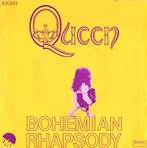
Nice French cover:
Brian May says of Bohemian Rhapsody: “Bohemian Rhapsody started off
really in Freddie’s head … It developed a little bit longer way, but basically
that’s Freddie’s dream or Freddie’s nightmare and it still lives on.”
With “Bohemian Rhapsody” came fame and wealth and recognition. The “A
Night at the Opera” album on which it was featured was considered as one of the
most expensive ever recorded when released in November 1975; it was a colossal
hit, giving Queen their first platinum album, established them as a leading
band of the era and turned them subsequently into one of the most popular bands
in pop and rock history. The single stayed at number one for nine weeks. No other song in Queen’s catalogue has achieved such a
legendary status and was voted the greatest single of all time by the Guinness
Book Of records in 2000. The video for the single, directed by Bruce Gowers and using ideas from the band, started the music
video craze. Queen was on top of the world.
Everywhere they went they were superstars; for his monumental song, Mercury was
even awarded his second prestigious Ivor Novello Award for songwriting.
Freddie Mercury explained it ‘only’ as “a personal song about
relationships” (which is also meaningful…), but when looking closer on its
lyrics it is the most complex/multifaceted song ever written by Mercury,
capable of thousands of different interpretations.
It has caused endless speculation about the possible
meanings behind its evocative lyrics: some say the song is about a trial or
about a suicide; there are also interpretations
that “Bohemian Rhapsody” could be a song “in which a Faust-like character
commits a sin, sells his soul and ultimately redeems himself”.
Brian May, however, confirms suggestions that the song contained veiled
references to Mercury’s personal inner life. “Freddie was a very complex
person […] he never explained the lyrics, but I think he put a lot of himself
into that song.” He says of Freddie’s typically obscure writing style: “Freddie’s
stuff was so heavily cloaked, lyrically. But you could find out, just from
little insights that a lot of his private thoughts were in there, although a
lot of the more meaningful stuff was not very accessible.”
Freddie Mercury: “’Bohemian Rhapsody’ didn’t just come out of thin air. I did a bit of research, although it
was tongue in cheek and it was mock opera. Why not? I certainly wasn’t saying I
was an opera fanatic and I knew everything about it … A lot of people slammed
‘Bohemian Rhapsody’, but who can you compare that to?”
“It’s one of those songs which has
such a fantasy feel about it. I think that people should just listen to it,
think about it and then make up their own minds as to what it says to them.”
My personal view…
I would like to start with
my personal relation to Bohemian Rhapsody. I hope, someone of you will
understand me – you know and probably have noticed, that there are people like ‘Faust’
or ‘Werther’ living on earth, searching for ‘the
Truth’ and seeking for spiritual growth... I think I’m even a little bit wrong
here – because maybe not only these ‘Faust like characters’/ ‘artists’ are
suffering and searching for a higher truth but really everyone of us to
a certain extent...
In the process of trying
to find these universal truths and values, you are confronted with many
different positions, philosophies, ‘worldviews’ –
sometimes there is really a battle going on inside of you so that in the end
it’s a long way of finding out of what you think is true and what is a lie/ or
what is ‘wrong’ and immoral and what is important or not...
Personally, I too had some
phases when I was just desperate with questions of the sort: “is there any
universal truth? (i.e. God or something that CONNECTS
us ALL...), or is this world meaningless – plain ‘fact’? – so that meanings
like ‘good’ or ‘evil’ mean nothing and/or are relative, only reactions of the
brain or whatever...
Now, I feel and I am very
sure that there is God/ ‘God’, something universal – as is love – it is only a
long process and lifetime task of recognizing these universal values and
finding your own way/ maybe even your own relationship to God...
… now
to Bohemian Rhapsody.: why do I think that this song is so connected with my
previous thoughts? I think that this song is exactly written in this
atmosphere, with this pain in the heart, of hoping to find God and to
see something good in our world (and even if already believing in God and love
to actually find this love in reality), to find your place in this
world... as well as trying to FIGHT the ‘evil’ and the NIHILISM, which
propagates that everything is hope- and meaningless…
Well, I hope I could express
what I personally think of Freddie’s masterpiece – I hope so much that someday
the entire world – everyone of us – will recognize the
beautiful side of life; peace and love to you allJ! (And back to my philosophical researchesJ)
© DARIA
KOKOZEJ
Interpretation
(©
copyright: Daria Kokozej, I
wrote this interpretation for my A-Levels school project in 2006)
Lyrically, the song appears to focus on a young man who seems to be at a
trial confessing that he has shot another man, and the emotional pain that he
endures as he faces the consequences of his actions. The song then continues
with an operatic section, where the fate of the young man appears to be
decided, and in the final, climactic rock section, the young man expresses his
rebelliousness against his fate before finally resigning himself to it.
To ‘gain access’ into the song’s deeper meaning, it is necessary to look
behind its surface, to think in metaphors, but also to keep in mind Freddie’s
multifaceted interests and life.
When listening to the music, “Bohemian Rhapsody” sounds very emotional,
as Freddie has put his whole heart into it. I sweeps form sweetly harmonised
confusion, through melodramatic upheavals as fleeing death, horror,
persecution, betrayal, to a final acceptance of all doubts and fears, resigned
but sorted.
At the beginning the protagonist seems questioning life, appearing
confused about the matter if his life or situation is real or not. He comes to
the conclusion that there is no escape from life; we cannot close our eyes,
there is no return from the consequences of our decisions or actions – or also
from our fate…
The phrase ‘open your eyes, look up to the skies’ can
mean on one hand: ‘live with your conscience, see the possibilities of life,
there is always a solution’, but from another point of view the listener
is told to look at a speaker in the sky; so our attention is directed towards
the sky when the speaker starts to talk. Probably the reason why the speaker is
in the sky is, because he is ‘dead’, but in a metaphoric sense.
After that we hear the boy introducing himself;
initially Mercury has written “I’m just a poor boy in need of sympathy” (click HERE for source – at ‘28th
Dec’) instead of the actual lyrics. He has
changed the lyrics to express that nobody really understands and loves the real
him, because he is ‘easy come, easy go, a little high, little low’, i.e.
practically living between two extremes like “Faust” by Goethe; the one side of
him is ‘high above the skies’, seeking for the truth, trying to understand his
‘real’ self, extrovert and could be on the artist side while the other side
lives ‘on the ground’, beset with earthly complexes and fears. ‘Anyway the wind
blows’, anyhow he is feeling now, nothing seems to matter him because he is
‘dead’/has changed or ‘cursed’ in some way.
Subsequently he confesses that he has shot a man. An
interesting fact is that he is a boy who has shot a man – somehow a ‘transformation’
is going on… We assume he has committed suicide, but not a real suicide: he has
killed his own old self and become someone different; with the death of his old
self he is beginning a new life, namely – in the case of Freddie – becoming an artist
(or ‘artist’).

We can suppose that the central character leads a monologue and that his
mother is alone as we don’t hear his mother’s reply. We just know that she is crying
(The symbol of the ‘mother’ in general can represent all people close to you). The boy then tells her that should she choose to turn her
back on him he will understand, and that she and his family and all people dear
to him must continue their lives because his destiny is an absolutely different
one. It is ‘too late’, there is no turning back, because he already has
decided to become an artist (or better: his fate was to be one) and
leaves everyone. But somehow he is not feeling good; he feels that the artists’
life itself for which he is predestined is difficult, takes a lot of
responsibility and you must make certain sacrifices – so in the same
time he has fears and doubts about such a lifestyle. Somehow he has a bad
feeling and there is obviously an emotional
struggle going on inside his head. The most likely reason why he feels uncomfortable is that
he feels his fate will going to have a tragic outcome; maybe he will be
sort of condemned…
Then he tells the listener that doesn’t want to die,
what means that he doesn’t want to fail in his life and he doesn’t want his
tragic destiny to be decided.
The middle section of the song has a very obscure
meaning. ‘Fandango’ is the name of a Spanish
dance, but also has an offshoot meaning which refers to a futile or hopeless
action. ‘Bismillah’ is Arabic and means ‘In the name of God’.

The speaker tells us that he see a silhouette, but we
don’t know whom it belongs; maybe it is his own silhouette so that he can see himself
literally from the side and understand what is going on with him and in
that way it is symbolizing the protagonist’s fate. The ‘silhouetto’
is calling him a Scaramouch whose life resembles a fandango. A Scaramouch is a
character from the Italian Commedia dell’arte. The
typical aspect of this character is that it makes people happy while being sad
in its heart. Mercury himself lived like a Scaramouch; he entertained people
and gave joy to them privately and with his music, but deep inside he was
lonely and rather unfortunate in his relationships.

The protagonist is afraid from the prophecy of his fate that plays a bad
joke with him. He cannot understand why his destiny will be ill-fated, because he
is just a boy and has no guilt – he is the victim of his circumstances, of all
misunderstandings etc…; but the destiny is sarcastic and merciless: ‘He’s just
a poor boy from a poor family, spare him his life from this monstrosity’.
The song continues with a sort of struggle, which could be a struggle in
the boy’s conscience or a struggle in which his
fate will be decided. The central character asks his fate for pity,
because he doesn’t want to have a tragic life and he asks to let him go,
release from the spell, but he concludes that ‘Beelzebub has a devil put aside
for him’; so, obviously his destiny will have a tragic outcome.
In the next section of the song the boy revolts against his fate, which rather
does resemble a doom that ‘spits in his eye’ and which is responsible for the
reality that beloved people are turning away from him because they don’t
‘understand’ him; subsequently he wants to impede his destiny, but he is not
able to do it. Finally, he resigns to fate, he
sadly has to make this tragic and paradox sacrifice for being an artist
and at the same time he is still partly afraid of it and senses that he will be
living like a victim of his fate, i.e. ‘condemned’ by it – but he accepts it.
The highly complex thoughts in “Bohemian Rhapsody”, Freddie’s opus,
prove that behind the surface of his showmanship and extravagant stage
personality there was an intelligent and emotional person.
The song portrays important and complex topics such as
life, personal existence, fate and personal worth. It
is called “Bohemian Rhapsody” because it depicts the life of a ‘bohemian’,
whose original meaning is ‘artist’ while ‘Rhapsody’ is a fantasy (literally, it
could play in his head) or a vision; within this song Freddie Mercury foresees
his life in a symbolic way.
Freddie Mercury has created an oeuvre which is open to
all sorts of interpretations and in that way universal.
+++ Wonderful statement by www.fmspiritoffire.com which I
really like – read also his brilliant study of Freddie’s life +++
“Freddie’s music is an entity in itself: the lyrics,
the rhythm, the structure, the music and the way it is played all join together
to create the song. Bohemian Rhapsody isn’t about the lyrics, it is about the
song in toto. In this case, it is a blend of different
forms of music, of different cultures it rises high
and sinks low, it weaves about the mind of the listener and the protagonist,
taking both on a journey through the song. The music, like all his music, is a
personal statement, but one which simply says: ‘I am me and I know who I am and
where I am and I don’t give a hang about what may come.’ This is the theme of
Freddie that is in his music: a man who exists and lives for the moment, a man
who is passionate, yet gentle, caring, yet dominating. Bohemian Rhapsody works
because it doesn’t tell us anything about Freddie in its lyrics, but it is
Freddie and it is his soul talking to us through the music.”
+++ I found a very interesting
interpretation of “Bohemian Rhapsody” in the web (at Songmeanings.net, but in
reality it is an extract from Ahundova’s book about
Freddie Mercury – see ‘books’ section), which I think is worth to read, enjoy!
+++

The
famous Bohemian Rhapsody (A Night at the Opera) is spiritual too. It’s the one
of the most popular Queen songs in 25 years, it’s
often aired on TV and radio all around the world. This little Mercury’s
masterpiece, combining classical and rock music, made a revolution in its time,
caused many parodies, imitations and remixes, and the mini film that
accompanied it became the first video clip in history. But, while everyone
loves the song, nobody explained what’s it about.
Mercury was elusively saying that he doesn’t even know himself,
or calling it “the song about human relations”. The critics were calling the
song nonsense, heavy, pretentious, absurd.
The
ones who hated Mercury the most were saying that he’s telling to do various mad
things, or calling the song a drug addict’s raving.
There was even an opinion that the author didn’t make any sense of the lyrics
at all – he just took the words that fitted the rhythm. The similar fruitless
discussions are still continuing. But, if you’d look at Bohemian Rhapsody as a
spiritual song, its meaning is more than clear.
In
the beginning of the video clip, Queen appears in the same prayer pose as on
Queen II cover. Then the text begins.
Is this the real life - or is it just fantasy
Caught
in a landslide - no escape from reality
Open
your eyes, look up to the sky and see...
”Is this the real life or is it just fantasy” – is a question concerning the
ideologies of Christianity (the monotheistic “Western” religion), from one
side, and of Buddhism, Hinduism and Daoism (the pantheistic, “Eastern”
religions), from another. In the “Eastern” religion, the world is just a
fantasy, an illusion, somebody’s dream - and nobody is responsible for their
actions: it’s all a fantasy! What’s the matter, if nothing really matters?
The
roots of escapism are in this ideology - escape from the reality, enter the
illusory world.
“No
escape from reality. Open your eyes, look up to the sky and see” – that’s how
Queen and Freddie answer this question. Life is real, and no matter what
illusions do you invent for yourself, you can’t escape from it. Everything
that’s happening isn’t a fantasy – it’s real, whether do you like it or not.
Freddie tells us to “open our eyes” – to admit the reality of this world.
Looking at the world with open eyes is one of the most significant differences
between Christian and Buddhist/Hindus philosophies – the latter tells to close yourself from the world and get into nirvana. While in
Christian art, the saints are pictured with wide open eyes, in Buddhist art the
saint’s eyes are always closed, and their faces look estranged.
To awaken yourself to the fact that life is real, you have to “look up to the
skies” – in other words, believe in God. That’s why there is said, “and see” – because faith has an answer for every question.
Then, the character of the song appears. We don’t know who he is, where he is
from, his name:
I’m just a
poor boy, I need no sympathy
Because I’m easy come – easy go,
Little high – little low,
Any way the wind blows, doesn't really matter to me, to me...
This guy is a typical modern escapist, the embodied indifference and
non-responsibility. He doesn’t care what’s going on around. He’s like a piece
of sand in the world.
Then, we learn that he killed a man:
Mama, just killed a man,
Put a gun against his head, pulled my trigger – now he’s dead.
Mama, life had just begun,
But now I’ve gone and thrown it all away.
Mama, ooh, didn’t mean to make you cry,
If I’m not back again this time tomorrow –
Carry on, carry on, as if nothing really matters.
Too late, my time has come,
Sends shivers down my spine, body’s aching all the time.
Goodbye everybody – I’ve got to go,
Gonna leave you all behind and face the truth
Mama, ooh (anyway the wind blows)
I don’t wanna die, I sometimes wish I’d never been
born at all...
The boy just killed a man – just for something to do or under a dose. He wasn’t
fully aware that if you’d shot a man, he dies from it, for him, it was just a
fun. He even doesn’t understand himself how it happened – he pulled the
trigger, as he’s seen in movies many times, and the man is dead, really dead.
The veil fell from his eyes, and now he’s facing his crime in the real world.
The boy is horrified by what’s happened, all is gone
for him. Now he’s going to commit suicide – that’s why he says goodbye to
everybody. He’s very scared; he doesn’t want to die and in the same time he
regrets that he was born. He’s got shivers down his spine, and body is aching
(it’s a very accurate description of fear of death), but he’s not able to stay
alive after all that’s happened and hold response for his action. Having
already committed one crime, now he’s going to commit one more senseless sin –
suicide.
And then, the most complicated and strange culmination part follows, featuring
a choir of many voices:
I see a little
silhouetto of a man,
Scaramouch, Scaramouch, will you do the fandango?
Thunderbolt and lightning very very frightening me.
Galileo, Galileo, Galileo, Galileo,
Galileo figaro Magnifico –
But I’m just a poor boy, nobody loves me.
He’s just a poor boy from a poor family,
Spare him his life from this monstrosity!
Easy come – easy go, will you let me go?
Bismillah! No, we will not let you go – let him go!
Bismillah! We will not let you go – let him go!
Bismillah! We will not let you go – let me go!
Will not let you go – let me go!
We’ll not let you go, never, never, never – let me go!
No, no, no, no, no, no, no!
Mama Mia, Mama Mia, Mama Mia, let me go –
Beelzebub has a devil put aside for me, for me, for me...
This
so-called “nonsense” is a great battle for the soul of this poor guy, in which
the heavenly hosts and the Hell’s demons participate. That’s why one choir
demands to let him go, while other choir says – we will not let him go. He
isn’t let go by the ones who made the boy escape from the reality, kill a man,
and now they’re making him to commit suicide to get his soul forever. It’s demons, one of which has been sent by Beelzebub to
overwhelm the soul of a poor boy. The boy is in a terrible trap – he wants to
get out of this nightmare, but he can’t. And, like a last hope, the choir
calls: “Galileo figaro magnifico”.
It’s the key phrase, which reveals the entire meaning of the song, and usually
it isn’t translated by the researchers. And, if they DO translate it, they
translate it from Italian, getting “Galileo is a great barber”.
What Galileo? What has barber to do with that?
Yes, it’s a nonsense. But don’t make Freddie an idiot.
Actually, it’s a slightly corrupted Latin phrase, “Galileo figuro
Magnifico” – translated as “Magnify the Galilean's
image”. “Galileo”, repeated five times, translated from Latin as “Jesus Christ”
– that was His name in the ancient
In his despair the guy appeal to God:
So you think you can stone me and spit in my eye
So you think you can love me and leave me to die
According to Eastern custom, the sinners were beaten with stones and the crowd
spitted to their faces. Such custom is described also in the Bible. So, it is
as if the guy says – and you dare condemn me – which has something in common
with the well-known words of Christ: “If any one of you is without sin, let him
be the first to throw a stone at her.” The second line is a polemic with the
Christian doctrine of the salvation of soul and, in the same time, a dispute
with God: how dare you say that you love me, and then let me die, without
helping me? Here we have an association with the last words of Christ: “Lord,
why did You leave me?” He doesn’t understand that the
help was already offered to him – but he refused it. And he accuses God of
having left him, of not helping him, of having condemned him…
Completely hopeless of everything, the boy finally decides to commit suicide –
“Just gotta get right outta
here”. The sad music sounds, lamenting the boy’s destiny, and the words:
“Nothing really matters to me... anyway the wind blows”.
And finally, the gong beat sounds, imitating the shot. Everything is ended. The
boy shot himself.
The
mysterious Bohemian Rhapsody is just a story of a bohemian boy who was taken
away with the Eastern occultism, which drove him firstly to killing, and then
to suicide. Since from the “human values” point of view this
song is a
monstrous heresy, it had to be declared “nonsense”.
Mercury
wasn’t angry at all the parodies of Rhapsody for nothing.
The
case isn’t in his ambitions – as we know, he had a perfect sense of humour and
liked to laugh at himself. He was irritated by the fact that the mass culture
vulgarized his song and never understood anything. And he wasn’t into casting
pearls before the swine…
+++
© Copyright 2006 - 2013; Daria Kokozej (Contact Me)